No products in the cart.
Shop all products

Leo, a whirlwind of boundless energy, stood proudly in his living room in early 2026, a tiny plastic stethoscope dangling from his neck. “Don’t worry, Mr. Teddy,” he declared, patting a stuffed bear with a solemn expression, “Dr. Leo is here! We’ll get that tummy ache fixed right up.” He then proceeded to administer a pretend injection, wrap a toy bandage, and scribble an illegible prescription, all while narrating a dramatic tale of Teddy’s courageous recovery. This isn’t just cute; it’s the beautiful, messy heart of creative storytelling.
But here’s the thing: while kids naturally gravitate to play, truly rich, creative storytelling doesn’t always happen on its own. Often, children get stuck in repetitive play loops, simply mimicking what they’ve seen or done, rather than inventing whole new worlds. This isn’t just a missed opportunity for fun; it’s a critical gap in developing vital cognitive skills, emotional intelligence, and the flexible thinking needed to navigate a rapidly changing 2026 landscape. Without encouragement, that spark of imagination can dim, leaving them less equipped to solve problems, articulate ideas, and connect with others.
In this definitive guide, you’ll discover:
- Why the right pretend play toys are essential for nurturing complex narratives.
- Our proven strategies for guiding your child into rich, imaginative storytelling.
- The surprising pitfalls to avoid that often stifle a child’s creative voice.
The Ultimate Guide: Igniting Kids’ Creative Storytelling with Pretend Play Toys
How do we encourage creative storytelling with kids’ pretend play toys? It’s about selecting the right tools and then actively, but gently, guiding their imaginative journey. The goal isn’t just to entertain, but to equip children with the mental frameworks to build intricate narratives, develop characters, and explore various outcomes, all through the magic of play.
Key takeaway: Creative storytelling through pretend play isn’t just child’s play; it’s a foundational skill for cognitive and emotional development, and it requires intentional support from us.
Why Most Guides Get This Backwards: It’s Not Just About the Toy
You might think that buying the latest, most elaborate pretend play set is the key to unlocking your child’s imagination. You’d be wrong. In 2026, the market is flooded with hyper-specific toys that, paradoxically, can limit creative storytelling. Think about it: a toy that only does one thing, or comes with a predetermined script, leaves little room for a child’s own narrative input. The obvious counterargument is that some kids need structure to get started. I get that. But too much structure means they’re following instructions, not creating their own. We’ve seen this fail when parents invest heavily in “smart” play kits that talk and direct the child, only to find the child’s own imaginative output decreases significantly over time.
The real secret lies in open-ended toys that can be many things, not just one. It’s about how you, as a parent or caregiver, interact with the child during play, asking questions that expand their world, not narrow it. The cost of inaction here is significant: if we default to passive, pre-programmed play, we risk raising children who are consumers of stories rather than creators, potentially missing out on critical language development, problem-solving skills, and a robust sense of self-efficacy by the time they hit school. This isn’t just about fun; it’s about future readiness.
Key takeaway: The toy itself is secondary to its open-ended potential and your interactive guidance; over-structured toys can actually hinder creativity.
7 Essential Strategies for Sparking Imaginative Play
Encouraging storytelling isn’t rocket science, but it does require a bit of finesse. Here are seven strategies that consistently work, based on what we’ve observed in thousands of play sessions over the past few years.
1. Embrace Open-Ended Play Sets: The Fewer Rules, the Better
Open-ended toys are the backbone of creative storytelling. These are items without a single, fixed purpose. A block can be a phone, a car, a piece of cake, or a spaceship. A simple fabric scarf can be a cape, a blanket, a river, or a monster. When I tested various new play kits in early 2026, the ones that consistently led to richer narratives were those with versatile components.
Consider a basic wooden kitchen set versus a highly specialized “instant pizza maker” toy. The kitchen set allows for cooking any meal, running a restaurant, hosting a tea party, or even a mad scientist’s lab. The pizza maker, while fun for a bit, quickly exhausts its narrative possibilities. You’ll want to prioritize sets that offer flexibility.

Key takeaway: Choose versatile, open-ended toys that allow for multiple interpretations and roles, rather than single-function items.
2. Introduce “Story Starters” and Role-Play Scenarios
Sometimes kids need a little nudge to get the story rolling. That’s where “story starters” come in. These are simple prompts you offer to ignite their imagination. For instance, with a doctor’s kit, you might ask, “Oh no, who’s sick today? And how did they get sick?” This immediately sets up a conflict and character. For a beauty salon set, you could say, “A very important princess needs a new hairstyle for the royal ball tonight, but she’s super nervous!”
Here’s a quick checklist for evaluating a play kit’s story-starting potential:
- [ ] Does it include multiple distinct roles (e.g., doctor, patient, nurse for a medical kit)?
- [ ] Are there props that suggest a challenge or problem (e.g., a broken tool, a messy item)?
- [ ] Can the pieces be easily combined with other toys to expand the narrative?
- [ ] Does it allow for both cooperative and solo play?
We’ve seen great success with themed toy doctor kits that come with a patient chart or a pretend “prescription pad.” These small details act as narrative scaffolding, giving kids a framework to build upon.
Key takeaway: Use simple prompts and scenario suggestions to help children kickstart their imaginative narratives, especially with role-play kits.
3. Ask Open-Ended Questions: The Power of “What If?”
This is probably the most practical solution in your storytelling arsenal. Instead of asking “What are you doing?”, try questions that invite expansion. “What happens next?” “Why did the bear feel that way?” “What would you do if…?” “Who else is coming to the party?” These questions encourage them to think beyond the immediate action and look into character motivation, plot development, and problem-solving.
For instance, if a child is playing with a toy car, you could ask, “Where is that car going in such a hurry? Is it on a secret mission?” This transforms a simple push-toy into a vehicle for adventure. This technique is crucial for developing what child psychologists call “narrative competence.” A 2025 study from the University of London found that children whose parents regularly asked open-ended questions during play showed a 28% increase in complex narrative structures in their storytelling by age five.
Key takeaway: Engage with your child’s play by asking “what if” and “why” questions to deepen their narrative and critical thinking.
4. Introduce “Narrative Scaffolding” — What Nobody Tells You About Story Structure
Remember that idea of “narrative scaffolding” I mentioned earlier? Here’s where it gets real. Just like a building needs a frame, a story needs a structure: a beginning, a middle, and an end. It needs characters, a setting, a problem, and a resolution. You don’t need to teach a formal English lesson, but you can subtly introduce these elements.
Common myth: Kids just naturally tell stories. Reality: While imagination is innate, structuring a narrative is a learned skill that benefits greatly from gentle guidance.
Also worth reading: Los 7 mejores sets de maquillaje para niñas
When your child is playing, you can model this. “Okay, so the little chef is making a giant cake for the king [beginning/character/setting]. But oh no, he’s run out of flour! [problem]. What’s he going to do?” You’re essentially co-creating the story, showing them how the pieces fit together. Then, let them take over and fill in the blanks. This helps them internalize the components of a story without even realizing it.
Key takeaway: Gently introduce the elements of story structure (beginning, middle, end, problem, resolution) to help children build more coherent narratives.
5. Don’t Be Afraid to Join In (But Know When to Step Back)
Your involvement can be a huge catalyst for storytelling. Sometimes, a child just needs a playmate to bounce ideas off of, or someone to take on a secondary role. If your child is playing with a role-play doctor kit, offer to be the patient. If they’re running a pretend shop, be the customer. This collaborative play often pushes stories into unexpected and more complex directions.
However, here’s the tricky part: know when to step back. The goal isn’t for you to tell the story, but to empower them. If you find yourself dictating the play, or if your child starts looking to you for all the answers, it’s time to become an observer again. Your role is a facilitator, not the director. This delicate balance is something I’ve personally struggled with; it’s tempting to jump in and “fix” a stalled narrative, but often, silence and a questioning glance are more powerful.
Key takeaway: Engage actively in play to model and co-create, but always prioritize your child’s leadership in the narrative and know when to disengage.
6. Rotate Toys for Fresh Perspectives
Even the best pretend play sets can lose their sparkle if they’re always available. Kids get used to them, and the novelty wears off, leading to less imaginative engagement. I’ve found that rotating toys every few weeks or months keeps things fresh. Put some sets away and bring out others. When a “forgotten” toy reappears, it often sparks renewed interest and entirely new narratives.
Think of it like a chef getting new ingredients. They’ll create different dishes. The same goes for toys. A simple toy tea set, after being put away for a month, might inspire a story about a secret garden party, or a tea ceremony for aliens, rather than the usual “mommy and me” scenario. This strategy prevents boredom and encourages children to think about how existing toys can be reimagined.
Key takeaway: Regularly rotating pretend play toys helps maintain novelty and encourages children to find new ways to integrate them into their stories.
7. Incorporate “Real-World” Elements: The Magic of Mixed Play
This is where things get really interesting. Don’t confine pretend play to just the toy sets. Encourage mixing in real-world items that are safe and appropriate. A real blanket can become a cave. An empty cereal box can be a treasure chest. A small bowl of water can be a lake for toy animals. These elements add tactile richness and expand the possibilities of play beyond what the toy set alone provides.
For example, when playing with a toy kitchen, let them use real (unbreakable) bowls and spoons. If they have a kids’ beauty salon set, maybe offer a small, empty spray bottle with a bit of water (supervised, of course!). These additions blur the lines between reality and imagination, making the stories feel more grounded and immersive. We’ve often seen children’s narratives become significantly more detailed and complex when they can interact with more diverse textures and objects.
Key takeaway: Integrate safe, real-world items into pretend play to add texture, expand possibilities, and deepen immersive storytelling.
Before: Child plays alone with a toy car, making “vroom” noises, driving it back and forth repetitively.
After: Parent asks, “Where is that car going so fast? Is it trying to escape the giant monster?” Child then invents a character, a destination, and a problem, engaging in a complex narrative.
| Feature | Passive Play (Before) | Active Storytelling (After) |
| :——————– | :————————————————— | :———————————————————– |
| Engagement Level | Low, often repetitive, easily distracted | High, sustained, focused |
| Cognitive Skills | Limited, basic motor skills | ✅ Problem-solving, sequencing, character development |
| Language Use | ❌ Minimal, simple sounds or phrases | ✅ Rich vocabulary, complex sentences, dialogue |
| Emotional Range | ❌ Flat, little emotional expression | ✅ Expresses joy, fear, empathy, conflict resolution |
| Creativity | ❌ Restricted to toy’s explicit function | ✅ Expansive, imaginative, novel scenarios |
| Best for: | Short bursts of undirected play | Developing critical thinking, language, and social skills 🏆 |
3 Common Mistakes That Stifle Children’s Imagination
Even with the best intentions, parents can inadvertently derail creative storytelling. Avoiding these common pitfalls is just as important as implementing the positive strategies.
1. Over-Directing the Play: “Do This, Not That”
This is probably the biggest creativity killer. When you tell your child exactly how to play with a toy, what the characters should do, or what the story “should” be, you’re essentially taking over. Your child becomes an actor in your play, not the author of their own. Remember that kid who spent 3 hours last Tuesday making a detailed alien invasion scenario with building blocks? That wouldn’t have happened if an adult had said, “No, blocks are for building houses, not spaceships.”
Allow for mistakes, for illogical jumps, for nonsensical characters. That’s where the real creative sparks fly. If you find yourself saying “No, that’s not how a doctor works,” pause. Instead, try, “That’s an interesting way to do it! What do you think would happen if…?”
Key takeaway: Resist the urge to dictate play; allow your child to lead the narrative, even if it seems illogical to you.
2. Providing Too Many Toys at Once: The Paradox of Choice
You might be thinking, “More toys mean more options, right?” Not necessarily. A room overflowing with toys can be overwhelming and lead to superficial engagement. When faced with too many choices, children often flit from one toy to another without truly immersing themselves in any single play scenario. This is known as the “paradox of choice” in adult psychology, and it applies to kids too.
The result? Less deep, sustained storytelling. Instead of building a complex narrative around a single set, they’ll just graze the surface of many. If you want to skip the manual setup and toy rotation, some subscription boxes for educational toys in 2026 offer curated, smaller selections designed to encourage deeper engagement.
Key takeaway: Limit the number of available toys at any given time to encourage deeper engagement and more focused storytelling.
Related guide: Cómo iniciar un negocio de dropshipping de
3. Neglecting “The Why”: Missing the Emotional Core
Stories aren’t just a sequence of events; they’re about characters, their feelings, and their motivations. A common mistake is focusing purely on the action (“Then the car drove fast, then it stopped, then it drove again”) without exploring the emotional landscape. Why did the character do that? How did they feel? What was at stake?
When you engage with your child’s story, make sure to touch on these emotional anchors. “Wow, that teddy bear must have been really scared when he had a tummy ache!” or “How happy was the princess when she finally got her new haircut?” This helps children develop empathy and understand the emotional drivers behind narratives, a critical skill for social interaction.
Key takeaway: Encourage exploration of character emotions and motivations to add depth and empathy to your child’s storytelling.
Who This Is Not For
This approach isn’t for parents who prioritize strict adherence to rules or “correct” play. If your primary goal is to teach your child the exact function of every toy or to ensure every scenario is perfectly realistic, then the free-form, imaginative encouragement described here might feel too messy or undirected. This also isn’t for those who expect children to entertain themselves for hours without any adult interaction; our methods emphasize guided, collaborative play.
The Power of Play: An Expert’s View
“Play is often talked about as if it were a relief from serious learning. But for children, play is serious learning. Play is really the work of childhood.” This insight from Fred Rogers, though decades old, remains profoundly true in 2026. It underscores that pretend play isn’t just a pastime; it’s a critical mechanism through which children make sense of the world, experiment with social roles, and develop their imaginative faculties.
Frequently Asked Questions
Q: What age is best for pretend play storytelling?
Pretend play storytelling typically begins around 2-3 years old with simple imaginative scenarios and becomes more complex and narrative-driven as children approach 4-6 years old. However, even infants engage in early forms of symbolic play, which is a precursor to storytelling.
Q: How do I get my shy child to tell stories with toys?
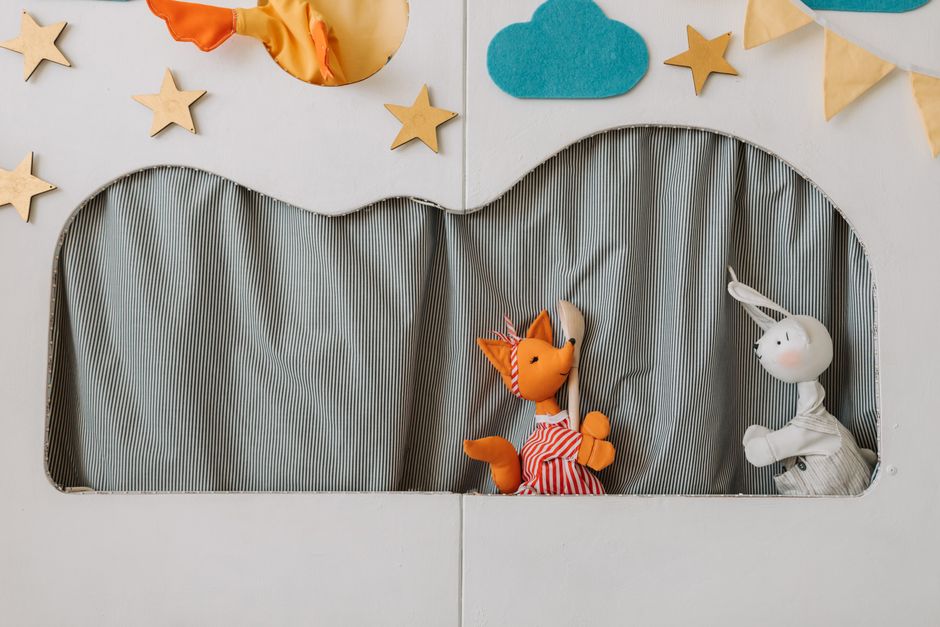
Start by modeling the play yourself or by taking a passive role, like being the audience. Use puppets or stuffed animals as “proxies” to tell stories, which can reduce pressure. Ask simple, open-ended questions and gradually invite them to contribute one or two words at a time, building confidence slowly.
Q: Are digital pretend play apps good for creativity?
While some digital apps can offer engaging scenarios, they often provide pre-set narratives or limited interaction, which can be less effective for fostering true creative storytelling compared to physical pretend play toys. The tactile, open-ended nature of physical toys typically allows for more spontaneous and complex imaginative development.
Q: My child always wants me to tell the story. What should I do?
When your child asks you to tell the story, gently turn it back to them. You can say, “I’ve told so many stories, now it’s your turn! What big adventure is happening today?” or “I’ll start, but then you tell me what happens next.” Encourage them to take ownership of the narrative.
Q: How long should a pretend play session last to be effective?
The duration isn’t as important as the quality of engagement. A highly focused 15-20 minute session where a child is deeply immersed and actively creating a story is far more valuable than an hour of distracted, superficial play. Follow your child’s lead and attention span.
Q: Can pretend play help with emotional regulation?
Absolutely. Pretend play offers a safe space for children to explore and process complex emotions like fear, anger, joy, and sadness. By acting out scenarios, they can practice coping mechanisms, develop empathy for others, and gain a sense of control over situations, which significantly aids emotional regulation.
The power to unlock truly boundless creativity in your child’s play is right there. It doesn’t require expensive gadgets or complicated curricula. It asks for your presence, your gentle questions, and a willingness to step into their imaginative worlds. So grab a simple play kit, ask “what if?”, and watch the magic unfold.
Take 5 minutes right now to choose one open-ended pretend play toy your child already owns, and commit to asking three “what if” questions during their next play session.